

 Supplying Cleanrooms Online for Over 20 Years
 Tailored Account Managed Solutions

Whether an organisation's primary concern is controlling micro-organisms for safety requirements, or physical contamination for yield and quality control purposes, an effective monitoring programme ensures the facility adheres to the relevant industry standards and guidelines.
However, cleanroom monitoring offers more than compliance; it's a strategic tool for ensuring consistent product quality, optimised processes, and risk mitigation.
In this blog, we address some of the common particle counter misconceptions and explain how these monitoring units support an effective contamination control strategy.
What are particle counters?
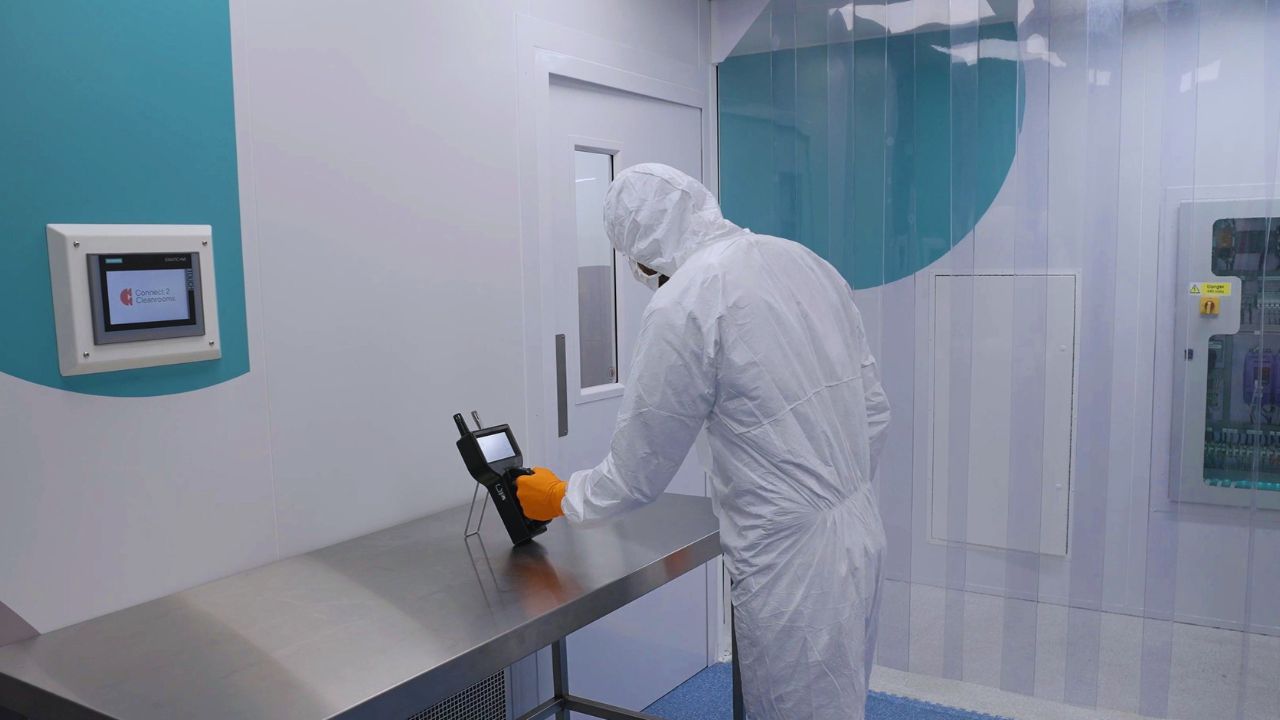
Particle counters are a monitoring tool used within controlled environments to identify and quantify the level of airborne particles under both 'at rest' and 'in operation' conditions.
As the only guaranteed method of recording and evidencing accurate air cleanliness levels, particle counters are widely used by a range of cleanroom applications including pharmaceuticals, electronics and semiconductors, research and development, and injection moulding.
Typically using light scattering to quantify the total number of particles within a defined size range, particle counters display readings in two columns; differential (the number of particles within a specific, defined size range) and cumulative (the number of particles from a minimum size, upwards).
Whether used for day-to-day monitoring, during contamination incidents, and as part of cleanroom validation, particle counters play a critical role in safeguarding sensitive applications, identifying process weaknesses, and evidencing compliance with ISO 14644 and GMP standards.
The common particle counter misconceptions
Particle counters are crucial for monitoring your cleanroom's performance and evidencing airborne particles during operation. However, there are many misconceptions around how these work and where they can be used.
1. Particle counters are only useful in GMP-classified facilities
A common misconception is that particle counters are only beneficial, or even required, in GMP cleanrooms. However, this is simply not the case. Particle counters are highly recommended across all facilities where airborne contamination is a concern.
Whilst ISO 14644 doesn't explicitly state that cleanroom environments must make use of a particle counter, regulated facilities must demonstrate compliance by evidencing that airborne particles are within a specifed limit, and the only guaranteed method of routinely monitoring and evidencing this is via a particle counter.
2. Particle counters are only used during cleanroom validation
Particle counters are used as part of cleanroom validation to quantify the level of airborne particles at both 'at rest' and 'in operation' states, with validation typically performed every 6 - 12 months depending on your classification. However, operators shouldn't solely rely on this to verify their cleanroom is operating as it should be.
Cleanroom monitoring using a particle counter should be part of your day-to-day processes, giving you a clear view of your cleanroom's performance in between validation testing and allowing you to troubleshoot any potential contamination incidents in the interim.
3. Particle counters can't detect particles smaller than 3 microns
Particle counters are designed to detect particles far smaller than those visible to the human eye. For context, the human eye can typically detect particles larger than 40 microns, with the average human hair measuring approximately 70 microns in diameter. However, many particles of concern within a cleanroom are significantly smaller. For instance, bactera are often around 1 - 2 microns in size, making them impossible to detect through visual inspection alone.
Many particle counters are capable of detecting airborne particles as small as 0.3 microns, enabling operators to monitor and evidence micro, airborne contaminants present within the space.
4. Particle counters are difficult to use, and only qualified validation engineers can use them
Initially, particle counters many seem complicated to use; however, many units are designed to be very user-friendly, with intuitive interfaces and straightforward data reporting to make cleanroom monitoring accessible to a wide range of personnel.
Whilst users should receive relevant training to understand the unit's various functions, specialist qualifications are not required for day-to-day use.
5. Particle counters are limited to take brief air samples
Many particle counters can be used for continuous monitoring, providing real-time, live data on particle concentration levels within a controlled facility. This allows operators to identify contamination incidents as they occur and understand the cleanroom's overall performance, rather than relying on intermittent checks and brief air samples.
6. Particle counters only need to be calibrated once
ISO 21501-4:2018 states, "The calibration of the LSAPC should be conducted at an interval equal to or shorter than one year". Over time, a particle counter's internal optics, lasers, and flow rates can naturally degrade, causing readings to drift and inaccurate results. Regular particle counter calibration verifies and resets the units against known, traceable standards, and is vital to ensuring your units are working optimally and outputting accurate and correct data.
Particle counters available at Cleanroomshop
Explore the range of handheld and remote particle counters available on Cleanroomshop for effective cleanroom monitoring. As the only way cleanrooms can ensure they're consistently meeting the air quality parameters set by ISO 14644 and GMP, particle counters provide you with accurate and reliable data to support you with contamination control.