

 Supplying Cleanrooms Online for Over 20 Years
 Tailored Account Managed Solutions


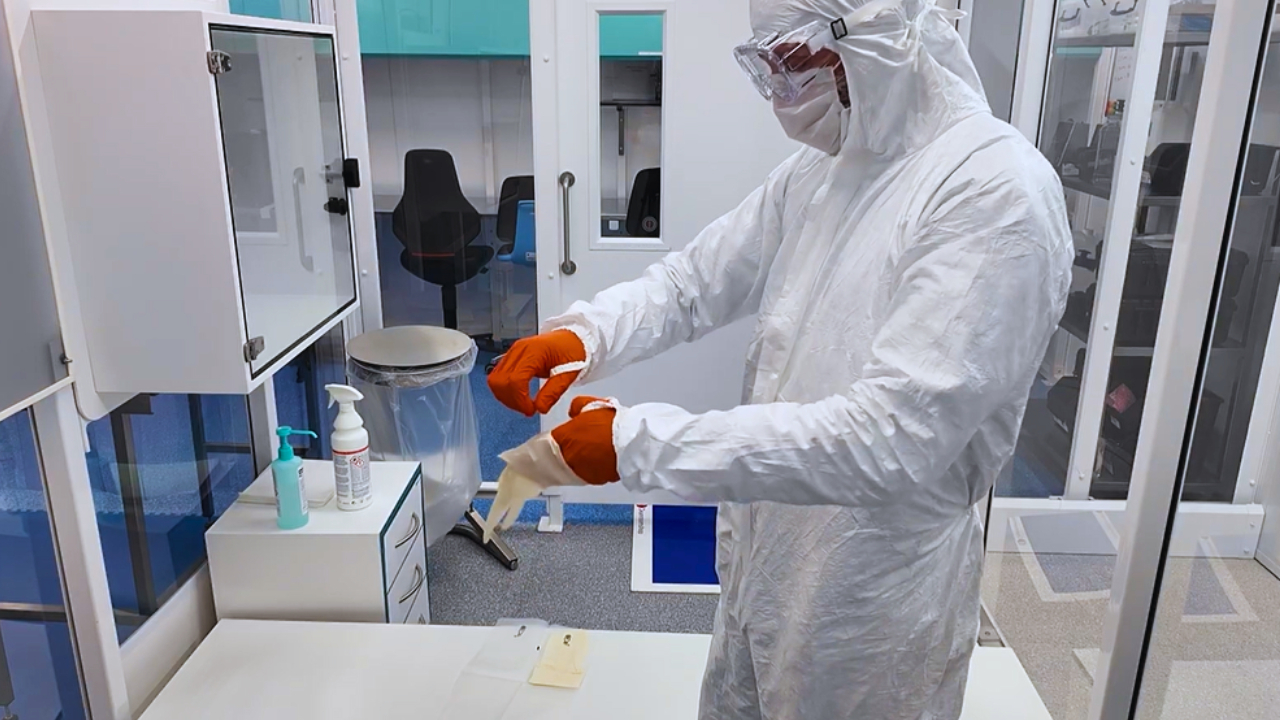
In high-risk cleanroom environments, double donning is often adopted as an effort to improve cleanliness, contamination control, and operator protection.
Dual-gloving gowning techniques is crucial in sterile applications and aseptic procedures, acting as a fail-safe barrier that reduces the exposure to pathogens, minimises the risk of punctures and tears, and allows for faster breach detection if an incident occurs.
In this blog, we’ll unpack double donning cleanroom gloves and its benefits, the step-by-step gowning technique recommended by Ansell, and which cleanrooms should look to adopt dual-gloving procedures.
What is double donning?
Double donning is a gowning method where a cleanroom operator wears two layers of gloves, one over the other. This highly recommended (and in some cases mandatory) practice provides precautionary benefits and additional protection for both application and operator in some of the most critical environments.
When double donned, each layer of gloves serves a distinct purpose; the inner glove provides a base layer of protection and particulate containment, while the outer glove acts as a barrier against potential breaches, such as punctures or tears.
Ultimately, double donning offers additional barrier protection and contamination control to safeguard both operator and application in particularly sensitive environments whilst maintaining high levels of dexterity and tactile sensitivity otherwise lost with thicker individual gloves.
The benefits and impacts of double donning
Cleanrooms and aseptic facilities who opt for double donning gowning procedures primarily do this for compliance, protection, and contamination control purposes. Double donning provides numerous benefits and impacts across each of these areas, including:
- Chemical protection: Multiple layers provide operators additional time to remove gloves before hazardous substances and chemicals penetrate the material and through to the skin.
- Puncture resistance: Double donning significantly reduces the overall risk of complete barrier failure down to just 7%, compared to over 50% for single gloves (Double Gloving – A Standard of Practice in Surgery, Ansell). While the outer glove may suffer micro-tears or punctures, the inner glove remains intact in the vast majority of cases.
- Visual breach indication: Within controlled facilities, a concern isn’t necessarily large tears in the PPE, but rather the micro punctures that aren’t typically visible to the naked eye but still release particles that could compromise the application or endanger the operator. By correctly double donning, especially with two pairs of gloves of opposing colours, operators can easily see small punctures in the glove’s material, allowing for prompt and effective replacement.
- Product and application integrity: By correctly applying two layers of gloves, this improves the containment of particles (including the shedding of skin flakes) and reduces the risk of contamination exposure within the environment and during production.
- Adhering to cleanroom standards: High grade facilities performing sterile, aseptic, or high-risk applications have an expectation from regulatory bodies to implement double donning techniques, demonstrating an approach that protects the environment and application. In EU GMP grades A and B, double donning is mandatory in order to achieve compliance, whereas in EU GMP grades C – D and also ISO class 3 – 5, double donning is highly recommended to maintain effective contamination control and protection, however, this is based on risk assessments and nature of applications performed in the environment.
How do you perform double donning techniques?
In Ansell’s Double Donning Technique for Sterile Cleanroom Gloves, they offer a handy, step-by-step guide on double donning for sterile cleanroom gloves.
- Step 1: Peel open the SMART pack;
- Step 2: Slide the inner wrap onto the donning table;
- Step 3: Unfold the inner wrap to full length. Open the inner wrap like opening a book;
- Step 4: Using the flaps where indicated, open the inner wrap and press down on the corners of the inner wrap to keep it flat;
- Step 5: Grip firmly at the folded cuff with one hand and slide the other hand into the glove, pull the folded cuff towards the wrist. Do not unfold the cuff! Do not touch the outside of the glove;
- Step 6: Then, insert your ungloved hand into the other glove and using your gloved hand, insert fingers into the cuff of the un-donned glove and pull-on, unfolding the cuff over your garment;
- Step 7: Slide your gloved fingers into the folded cuff of the first donned glove;
- Step 8: Unfold the cuff of the first glove until it overlaps the sleeve;
- Step 9: Don the rest of your garments and proceed to step 10;
- Step 10: Retrieve the outer glove;
- Step 11: Open the inner wrap using the flaps. Once opened, press down on the corners of the inner wrap to keep it flat;
- Step 12: Grip firmly at the folded cuff and slide the first gloved hand into the outer glove. Pull the folded cuff towards the wrist. Do not unfold the cuff!
- Step 13: Slip the fingers of the double-gloved hand into the cuff of the remaining outer glove. Pull the glove up over the hand and unfold the cuff over the sleeve;
- Step 14: Slip fingers into the cuff of the first donned outer glove and pull up over the sleeve.
This donning guide is for guidance purposes only, site protocols and procedures should be followed at all times.
Which cleanrooms need to double don cleanroom gloves?
Those manufacturing sterile medicinal products in an EU GMP grade A – B environments, double donning cleanroom gloves is mandatory in order to achieve compliance. These facilities must demonstrate appropriate gowning techniques with suitable PPE, including double donning techniques, in order to maintain the highest levels of cleanliness in some of the most critical environments.
It's also highly advised that the ISO 14644 equivalent, ISO class 4 – 5, adopt double donning in these areas. However, unlike Annex 1, the ISO 14644 standard only measures and establishes suitable airborne particulates during operation. However, if a cleanroom’s established Contamination Control Strategy (CCS) specifies the need for double donning based on the nature of the application and risk assessments, operators should consistently follow this gowning approach to maintain conformity, reduce contamination risk, and minimise the release of particulates into the environment.
Single gloving is typically sufficient for less critical environments including ISO class 6 – 8 or EU GMP grades C – D as higher particle counts are permitted in these areas. However, double donning may still be recommended based on application and risk assessments.
Our recommended cleanroom gloves for double donning
Our range of cleanroom gloves suitable for double donning protect both the operator’s hands and applications by preventing particle transfer and micro-organisms from compromising product integrity and minimising the wearer’s risk of harm.
Browse Ansell’s range of disposable cleanroom gloves including BioClean™, Kimtech™, TouchNTuff™, and DermaShield™, suitable for sterile, aseptic facilities and those looking to implement double-donning gloving techniques.